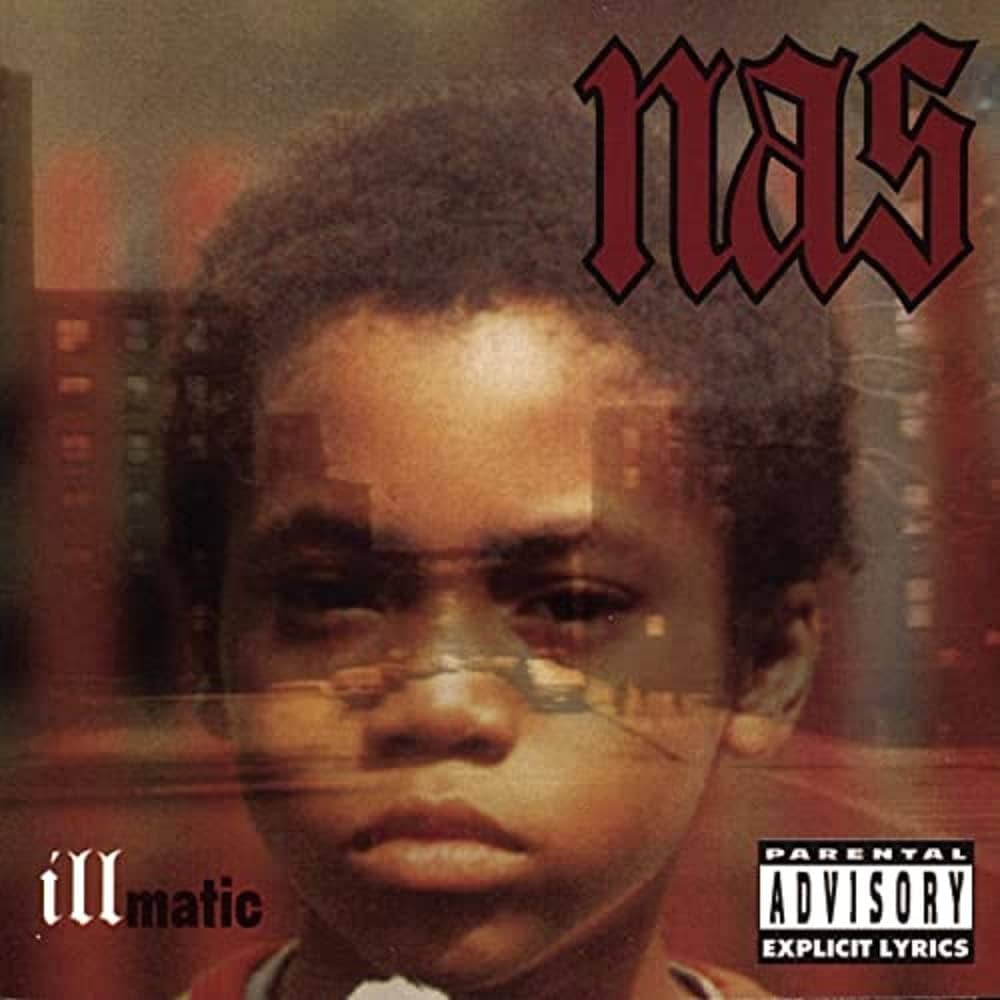
Everywhere you look, it is almost universally agreed that Nas’ 1994 debut, Illmatic, is not only one of the greatest hip-hop records of all time; but one of the greatest records of all time. The album holds the coveted 10 rating on Pitchfork, is ranked 14th highest on Rate Your Music, was inducted into the Library of Congress for its cultural significance (the first of its genre), and cited by many artists as their inspiration for making music. Illmatic broke the West Coast-centric mold of the early nineties and of music as a whole, with its influences still playing out today.
“The Genesis”, a short skit that opens the record, beautifully sets up Illmatic’s exploration of life in Queensbridge—the largest housing project in America. In it we hear faint echoes of Nas’ first ever recorded rap performance on Main Source’s “Live At the Barbeque” when he was just 17 years old, followed by fuzzy synth notes and the sounds of a subway train. The bulk of the skit’s message comes through a dialogue sample from the classic 1983 film Wild Style, one of the first movies to depict hip-hop on film. In the skit, a character complains about the other always being at home, working on his writing, and telling him that his craft won’t help him escape the disadvantages of his urban community, that there is no way out. The other character, which we can presume to be speaking from Nas’ perspective, replies, “Oh yes, there is. There’s this,” implying a love for the craft and that hip-hop is enough for him.
Nas’ Illmatic wasn’t the first Hip-hop record to depict street violence, drug use, and crime in the inner-city environment from which it originated. From its genesis, hip-hop has always made those realities clear and was always explicitly against systemic issues. But never was it presented in such a personal way. In recent times, records like these are often taken for granted. One could list Kendrick Lamar’s Good Kid M.A.A.D. City, JID’s The Forever Story, and many more as examples. But, without Illmatic, this method of storytelling commonly known as the “ghetto reporter”, may not exist. Nas doesn’t just depict these realities on Illmatic, he reacts to them. The most famous line of many off of the dark, chaotic “N.Y. State of Mind”, reads “I never sleep, cause sleep is the cousin of death,” encapsulating that feeling of always having to be on your toes and not knowing if you will see the next day. Personal reactions like this are integral to the fabric of modern Hip hop.
Following the dark, in-your-face realities of “N.Y. State of Mind” and its companion track, “Life’s a Bitch”, we come to what I believe is Nas’ best song, “The World is Yours”. Which is, at its core, an anthem directed at the people around him. As the title implies, the song is pointed at you, the listener, but Nas also writes to himself. The track before, “Life’s a Bitch”, looks around at the realities Nas himself faces and takes a defeatist standpoint wherein Nas chooses drug use to escape the idea that, “Life’s a bitch and then you die”. In contrast, “The World is Yours”paints a brighter picture and encourages the listener to keep working at their goals and to pass on their experiences to the next generation. The track has amazing Pete Rock production, featuring an iconic loop sampled from Ahmad Jamal’s 1970 jazz piano explosion “I Love Music”. Nas has said it “has a life of its own even without a single word”. I would argue it is one of the greatest examples of production the genre has to offer.
Next is “Halftime”, which is a great showing of Nas’ lyrical abilities over another booming beat. One of the techniques Nas uses on this song is enjambment, where, due to his high-syllable rhymes, he shoves the ending of his line into the next, sometimes connecting the two and creating double entendres. “Memory Lane (Sittin’ in da Park)” is a laid-back reflection on the environment of Queensbridge. Nas looks around for cops, reflects on knife fights, and how marijuana use eases the stress that comes with those memories. However, the reality cannot be avoided; “My window faces shootouts, drug overdoses, Live amongst no roses, only the drama, for real, A nickel-plate is my fate”. Nas’ only view into the outside world is fraught with stress and violence, pushing him to the same outlook. “One Love (feat. Q-Tip)” might be the most advanced songwriting on the record. Nas writes from the perspective of the friend of a prison inmate updating them on happenings at home. The song is somber, the tones of the beat echoing into emptiness. Even though Nas’ frustration with the situation comes through on the song, towards the middle and end, he gets very vulnerable; “Stay civilized, time flies, Though incarcerated, your mind dies, I hate it when your moms cries”.
Immediately jumping back into energy and lyricism, Nas’ “Represent” paints a classic picture of street life and bravado. The chorus, “Represent y’all, represent!”, features many ecstatic voices recorded outdoors, presumably in Queensbridge, and along with the high synths of the beat, this track captures the feeling of being outdoors on a cold New York morning. Nas describes his criminal plans, the clothes he wears, and his ambitions to gain financial status. This track is an absolute banger, and again, the influences of Nas’ choices of subject matter are clear in modern Hip-Hop. The last track of Illmatic, “It Ain’t Hard To Tell”, is an homage to Nas’ writing process. Defining his work in supernatural, powerful vocabulary over an amazing, fast-paced beat sampling Michael Jackson’s “Human Nature”, with both synths and Jackson’s vocal cuts.
It was only natural that when Nas announced he would be performing Illmatic with the National Symphony Orchestra at Wolftrap, I knew I had to go. Lawn tickets were dirt cheap, and there was no way I was going to pass it up. I invited my girlfriend, my sister, and her boyfriend to tag along. We had a rotisserie chicken dinner on the lawn, and I went a little too crazy on the taco-flavored Doritos. Then, I heard the clacking of the New York City subway play out over the loudspeakers, and Nas walked out on stage. He sported a white tuxedo and carried a glass of champagne and a microphone. The Orchestra and DJ Green Lantern stood and watched as though he were a conductorNas played through the album, and though his vocal performance waned considerably, he managed to rap nearly the entire record without too many breaks. Meanwhile, I probably hit more of the words than he did, but only because I wanted to show to my girlfriend that I knew them. I found the speeches he gave in between tracks to be inspiring, with the Orchestra backing giving his words serious power. Sure, it was the same old “Never give up” type deal, but coming from him it really does mean something. You could see that this tour meant something to him, because the emotions of his music came alive on stage. After Illmatic, Nas played through some of his hits, a highlight being “Made You Look” off of his 2000 album, God’s Son. The song is full of the cinema and excess of early 2000s Bling-rap, but with all the technical expertise of a seasoned 90s emcee. The beat bangs and iconic chorus made the crowd wild. After the concert ended, and as Nas gave a closing speech, the stoner behind me tapped my shoulder and said, “Hey! You really know your shit, man,” and that he hoped I’d return in ten years for the next show. Though someone like Nas, something like classic Hip hop, and a symphony orchestra wouldn’t seem to be even compatible at face-value, the show was an absolute blast. Looking back, I still can’t believe I was lucky enough to see this album performed by such a living legend. Nas’ critics often cite his inability to overcome the massive achievement that Illmatic was, but they only point this demand at him because no other artist can.