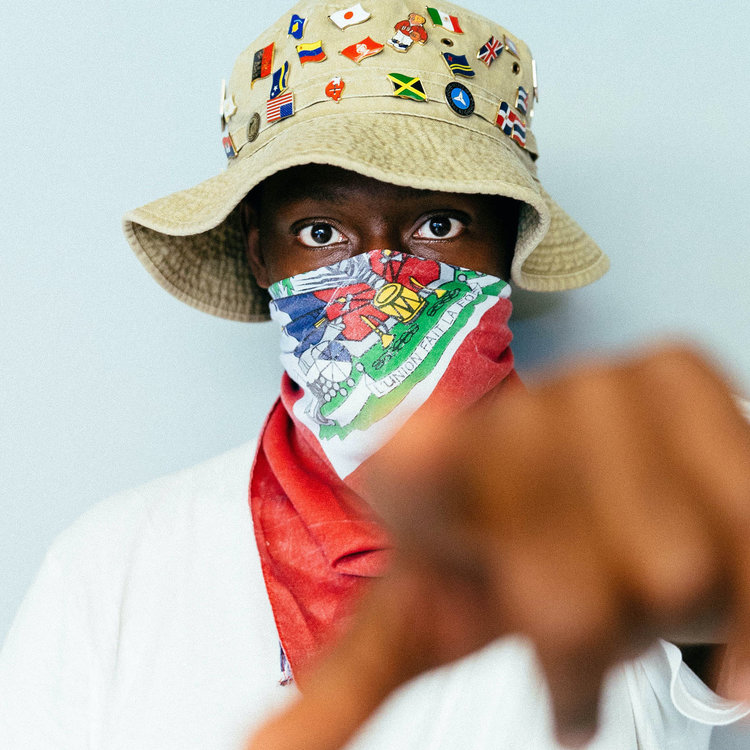
Who is Mach-Hommy? If you have heard his music, you could say he is a rapper. Hommy has gained a reputation for a near constant work ethic, a gritty delivery, and unparalleled lyricism. If you did some googling, you might know that he was born in Port-au-Prince, Haiti, and raised in Newark, New Jersey. You probably would know of his associations with the Griselda collective, including artists like Westside Gunn and Tha God Fahim. You could dig through his hugely extensive, widely varying discography, but that’s it. Mach-Hommy is often labeled as “The Most Mysterious Man in Hip-hop,” and this mystique is entirely intentional. Hommy makes no public appearances, has no social media presence, and never shows his face. He is often compared in that respect to the late MF DOOM, an emcee who hid his face his entire career, but DOOM and Mach-Hommy differ in that, for a period, Hommy seemed to restrict access to his music. This decision seems entirely counterintuitive for someone trying to make a living, but seemingly it paid off. Hommy gained his first attention when he released his 2016 record, Haitian Body Odor in a limited CD press, each for $300. Of course, Hommy already had garnered a cult following by this point, and thus, they bought it out. His most loyal fans have shilled up to $7,000 for physical copies of his work upon first release. He primarily occupied the music sharing site Bandcamp, before moving some of his work to popular streaming service Soundcloud in 2017. Hommy continues to re-release his older projects on streaming, thus the volume of his discography cannot be measured using normal factors.
Plenty of images of Mach exist online, but they are restricted to his music video appearances, and occasional studio meetups with other artists like Westside Gunn. On that note, Mach-Hommy’s popularity skyrocketed in 2021 following the release of Pray for Haiti, his most widely-known studio album, and he was endorsed by many artists with followings much larger than his own, such as Kanye West, Drake and Jay-Z. More lesser-known artists, like the legendary Yasiin Bey (formerly Mos Def) came out to encourage listeners to tap into Mach’s work. This resulted in increased collaborations from Mach with other artists, most notably the repeated appearances with West Coast rapper Earl Sweatshirt. Though Pray for Haiti brought him much attention from the mainstream, and notable inclusions in end of year rankings, it did not translate into widespread popularity or appeal, probably due to Mach-Hommy’s resistance to having an online presence. That being said, Hommy seems to be a thriving entrepreneur in his private life. In a surfaced video during the COVID-19 pandemic, Mach-Hommy appears feeding farm animals, and bragging about how everyone is stuck inside while he can freely be outdoors. Again, I cannot give proper details because I saw this video years ago, and it seems to have been scrubbed entirely off the internet. From GQ, a popular magazine, we know that Hommy records in an isolated studio belonging to a famous film score composer overlooking the pacific, only accepting interviews from journalists as elusive as he is, people with no information on the internet. Hommy only recently performed his first live show, which of course, had a no phones policy and highly expensive tickets. Some fans even claim that they spotted him as an extra in movies and TV. Mach-Hommy purposely misleads, tricks, and blocks his fans from any information about his private life or his music, leaving his fanbase to pick up the pieces.
This mystique carries over into Mach’s music. Again, Hommy garners MF DOOM comparisons from his clever wordplay, erratic deliveries, and hugely innovative lyricism, but none of his lyrics are explicit or easy to pin definitive meanings onto. This could be the reasoning behind purposefully hiding them from his listeners, further creating a sense of ambiguity and confusion. His production does this even more so, using extremely obscure instrumentation, distortion and layering to achieve a surreal quality that most artists cannot even touch. Another key part of Hommy’s music is his Haitian identity. His raps are often considered “bilingual” due to his way of sprinkling Creole throughout his songs, sometimes even sandwiched between english. This choice itself further muddies the waters of Mach’s music. Haitian Creole is hyper-regional, with dialects and terminology differentiating on an extremely local level. It makes translating Mach’s Creole even harder than it already is to translate the extended metaphors he weaves into his poetry in english. Overall, Mach-Hommy is part of a new renaissance of Hip-hop, one with decreased label control and an artistic focus on crafting distinct identities. An icon, who is both everywhere, and nowhere.
A few of my favorite tracks include: “Margiela Split Toes (feat. Mach-Hommy)”, “Self Luh”, “The Stellar Ray Theory”, “Marie”, “The 26th Letter”, “Folie A Deux (feat. Westside Gunn”, “$payforhaiti (feat. Mach-Hommy), “Embarrassment of Riches (Choops), “Soon Jah Due (feat. Earl Sweatshirt”, “Continental Breakfast”, “d’Shady and d’Lamp (feat. Tha God Fahim”, and “Newark”